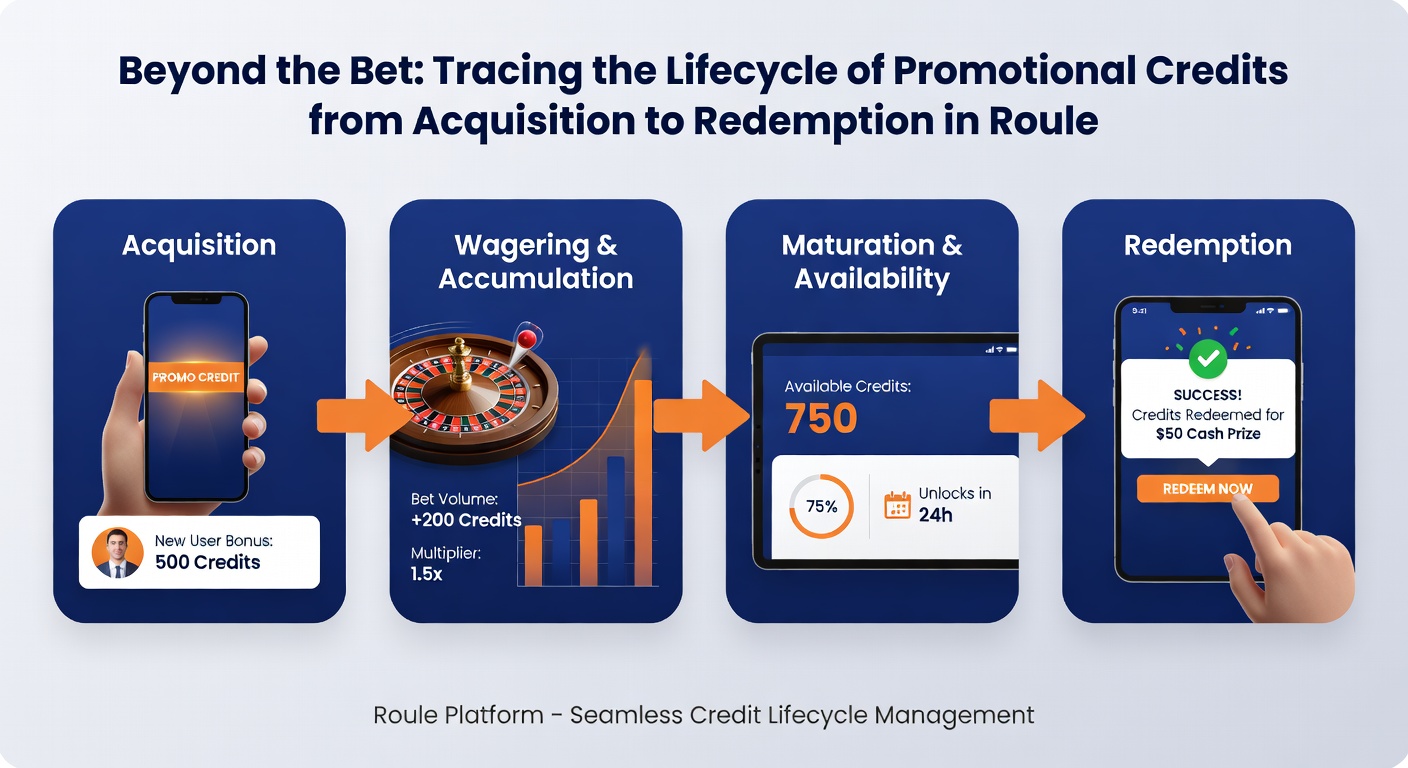
Beyond the Bet: Tracing the Lifecycle of Promotional Credits from Acquisition to Redemption in Roulette Play
 Promotional credits in roulette begin their journey at the acquisition stage where players obtain them through deposit matches, no-deposit offers, or loyalty rewards on licensed platforms, and these credits then move through verification steps that confirm eligibility before any play can start. Operators issue the credits based on specific triggers such as minimum deposit amounts or account registration milestones, while data from the Nevada Gaming Control Board shows that acquisition volumes have risen steadily in recent years as digital payment options expand across multiple regions. The credits enter a holding period during which systems apply terms like wagering multipliers that dictate how many times a player must bet the credit value before accessing cash equivalents. Researchers at the University of Sydney have documented how these multipliers typically range from 20x to 50x depending on the promotion type and game category, with roulette often carrying higher requirements because of its house edge profile. Players see the credits appear in their account balance as a separate ledger entry that remains distinct from real money until redemption conditions are fully met.
Activation Mechanics and Initial Play Restrictions
Activation requires players to select eligible roulette variants where the credits can be applied, and many platforms limit use to European or French wheel formats that feature lower house edges compared to American versions. Once activated the credits generate virtual chip stacks that allow bets to proceed under automated tracking software which logs every spin outcome against the required wagering total. This phase creates a clear separation between promotional funds and deposited cash, ensuring that operators can monitor compliance without mixing the two categories. Observers note that restrictions often include maximum bet limits per spin to prevent rapid depletion of the credit pool, and these caps usually sit around 10 percent of the credit value to stretch the lifecycle across multiple rounds. Systems flag any attempts to exceed these limits automatically, which forces players to adjust their stake sizes accordingly before the round begins.Wagering Progression and Tracking Systems
As play continues the promotional credits move through incremental reductions in the remaining wagering requirement, with each qualifying bet subtracting from the total needed to reach redemption status. Tracking occurs in real time through backend algorithms that distinguish between winning and losing spins while only crediting the wager portion toward completion. Data indicates that roulette sessions tend to show slower progress because the even-money bets that many players favor contribute steadily but without accelerating the multiplier fulfillment dramatically. Platforms display progress meters in user dashboards that update after every spin, giving players a visible indicator of how close they stand to the next phase. These meters pull from centralized databases that log all activity across devices, which maintains consistency even when sessions span multiple days or locations.